The recent Global Nature Positive Summit in Japan brought together leaders from business, government, finance, conservation, and civil society to accelerate action towards a nature-positive future. With more than 2,700 participants from around the world, the Summit heralded growing international momentum behind efforts to halt and reverse biodiversity loss. Building on the inaugural Global Nature Positive Summit in Sydney in 2024, which convened more than 1,000 global leaders, the 2026 Summit reflected a significant expansion in participation and engagement, IBAT was proud to contribute to this year’s Summit.
The Summit culminated with the announcement of the Kumamoto Declaration, a significant call to action ahead of CBD COP17. The Declaration has been signed by 85 organisations, with businesses accounting for more than half of the signatories. It recognises the critical urgency of accelerating action to deliver the nature-positive goal of halting and reversing biodiversity loss by 2030, measured against a 2020 baseline, and achieving full recovery by 2050. The Declaration aligns with the mission and vision of the Kunming-Montreal Global Biodiversity Framework and reinforces the essential role of cross-sector collaboration in achieving global biodiversity goals. The Declaration's emphasis on science-based, standardised approaches to biodiversity assessment, measurement and reporting closely aligns with IBAT's mission to provide authoritative biodiversity data that supports informed decision-making, disclosure and action for nature across sectors.

The representation from the private sector throughout the Summit highlighted the growing recognition that business has a vital role to play in driving nature-positive outcomes. There was a particularly strong presence of senior corporate decision-makers, reflecting biodiversity's growing importance as a strategic business issue. Discussions throughout the Summit demonstrated a growing appetite among businesses for credible data, practical tools, and actionable guidance to support biodiversity risk assessment, disclosure and nature-positive decision-making. The growing interest in nature finance among businesses and financial institutions also highlighted the need for robust biodiversity information to support investment decisions and drive measurable nature-positive outcomes.
The Summit also illustrated how many organisations are now moving beyond biodiversity awareness and commitments toward implementation, creating demand for practical solutions that can support action at scale. This marks an important evolution from the first Summit, where discussions focused more on building awareness and establishing frameworks for nature-positive action. As Her Imperial Highness Princess Takamado of Japan observed, "Nature can survive without us; we are the ones who must get our act together."
Together, these developments signal increasing commitment and momentum as the global community looks ahead to CBD COP17 and the next phase of implementation of the Global Biodiversity Framework.
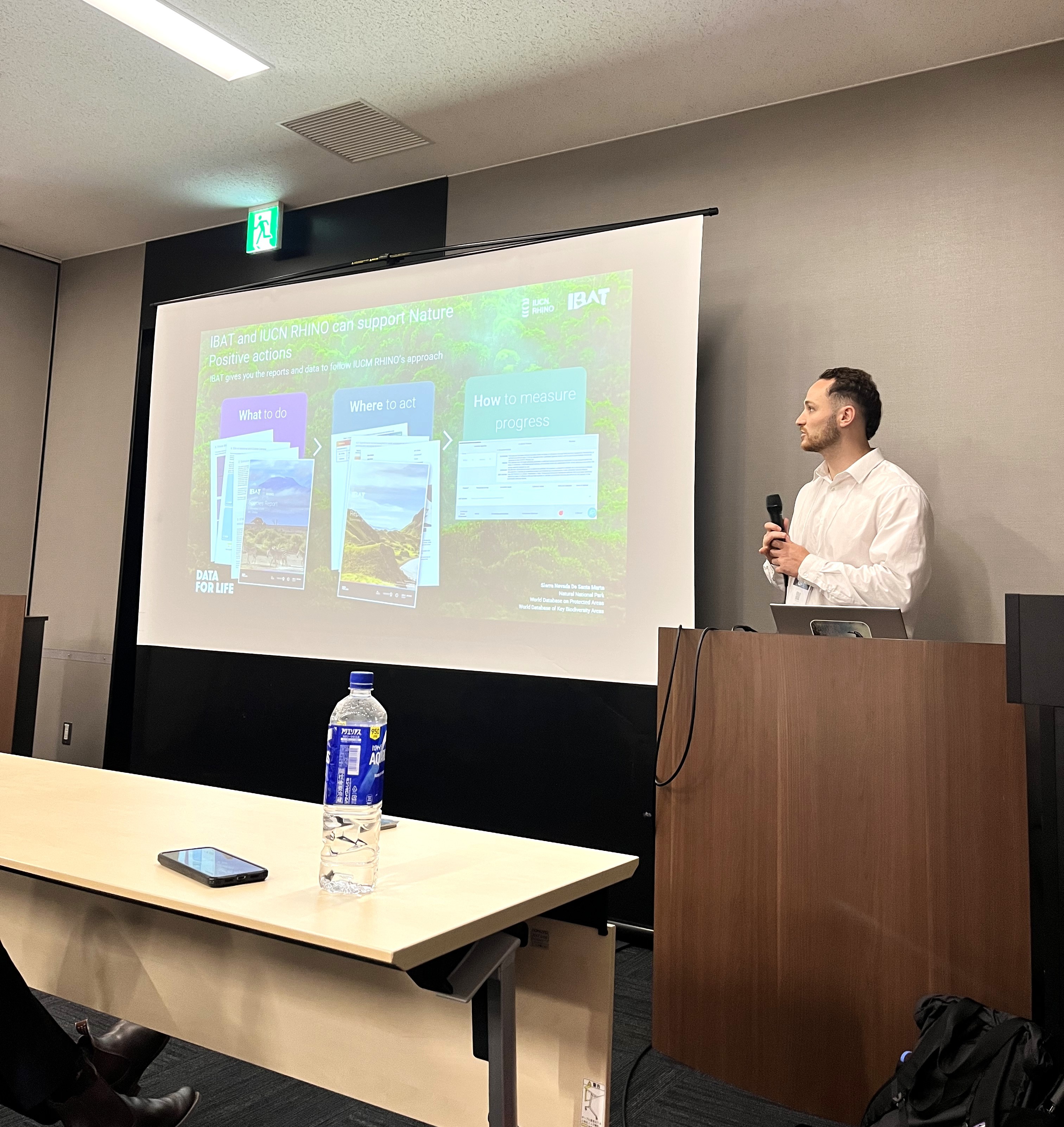
IBAT hosted the two events below during the Summit, welcoming stakeholders from around the world, reflecting the increasing importance of biodiversity data and tools in supporting informed decision-making across sectors:
Delivering Nature Positive outcomes: IBAT, IUCN RHINO and other tools and approaches for measurable impact.
Participants had the opportunity to hear about IUCN RHINO, IUCN’s approach for delivering Rapid High-Integrity Nature Positive Outcomes. APRIL, a global leader in the pulp and paper industry and one of IUCN’s corporate partners, shared reflections on their piloting of the RHINO approach, and key lessons learned.
The session also offered an overview of how IBAT provides reports and analysis that support both disclosure and nature positive action, supporting companies to algin with RHINO, NPI’s State of Nature Metrics and TNFD’s LEAP approach. Think Nature also shared how they approach supporting value chain assessments. The session concluded with reflections from the speakers on critical challenges, solutions and opportunities to help scale corporate action on nature.

A Nature-Positive Workshop Using IBAT and the IUCN RHINO Approach
In this session, conducted with the support of Taisho University and moderated by Professor Naoya Furuta, experts showcased how the IBAT platform helps advance nature positive action in practise using existing tools such as the Species Threat Abatement and Restoration Metric (STAR) and the IUCN RHINO approach. The session offered a deep dive into world-leading tools and approaches and participants had the opportunity to ask questions of the experts, leading to an engaging discussion between participants from civil society, business and government.
Reflecting on the Summit and related engagements, IBAT Japan Representative, Business and Biodiversity, Eri Uchimura, said: "I was inspired by the strong commitment shown by leaders from business and financial institutions, across Japan and the wider region. What stood out most was how keen companies are to engage with biodiversity issues and seek practical pathways to action. The openness and enthusiasm of the conversations was inspiring, with many companies interested in exploring how biodiversity data could be applied more widely across their organisations. These discussions reinforced that credible biodiversity data is becoming increasingly important for businesses’ decision-making. I am excited about the role IBAT can play in helping organisations access the insights they need to accelerate progress."
.jpg)
As momentum continues to build ahead of CBD COP17, we look forward to continuing to support organisations around the world to make informed decisions and raise the bar for nature, based on authoritative biodiversity insight.
If you are seeking insights, please get in touch with our team to see how we can help you at ibat@ibat-alliance.org.