.jpeg)
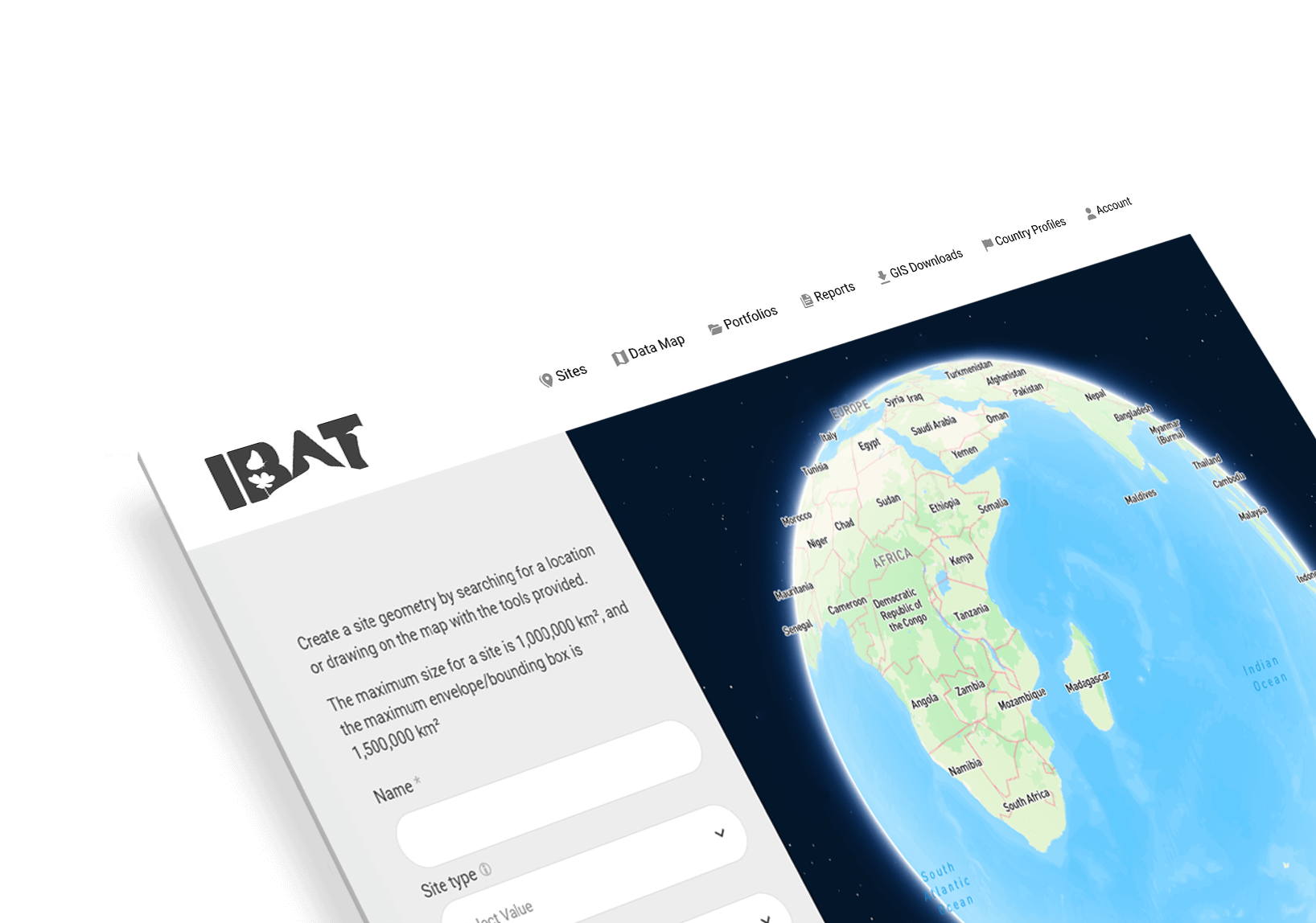
The updated IBAT PS6 & ESS6 Report delivers a more granular approach to biodiversity screening. Aligned with the 2019 revision of International Finance Corporation Performance Standard 6 (IFC PS6) Guidance Note 6 and the World Bank Environmental and Social Standard 6 (ESS6), the report provides users with deeper insights to help identify and assess biodiversity-related risks with greater confidence.
The report supports early-stage, project-level due diligence by identifying potential triggers across the five critical habitat criteria defined under IFC PS6. Using the most up-to-date global biodiversity datasets, it enables users to prioritise further assessment and better manage financial and reputational risks.
Key Enhancements and New Features
All existing functionality is retained, with several key enhancements introduced:
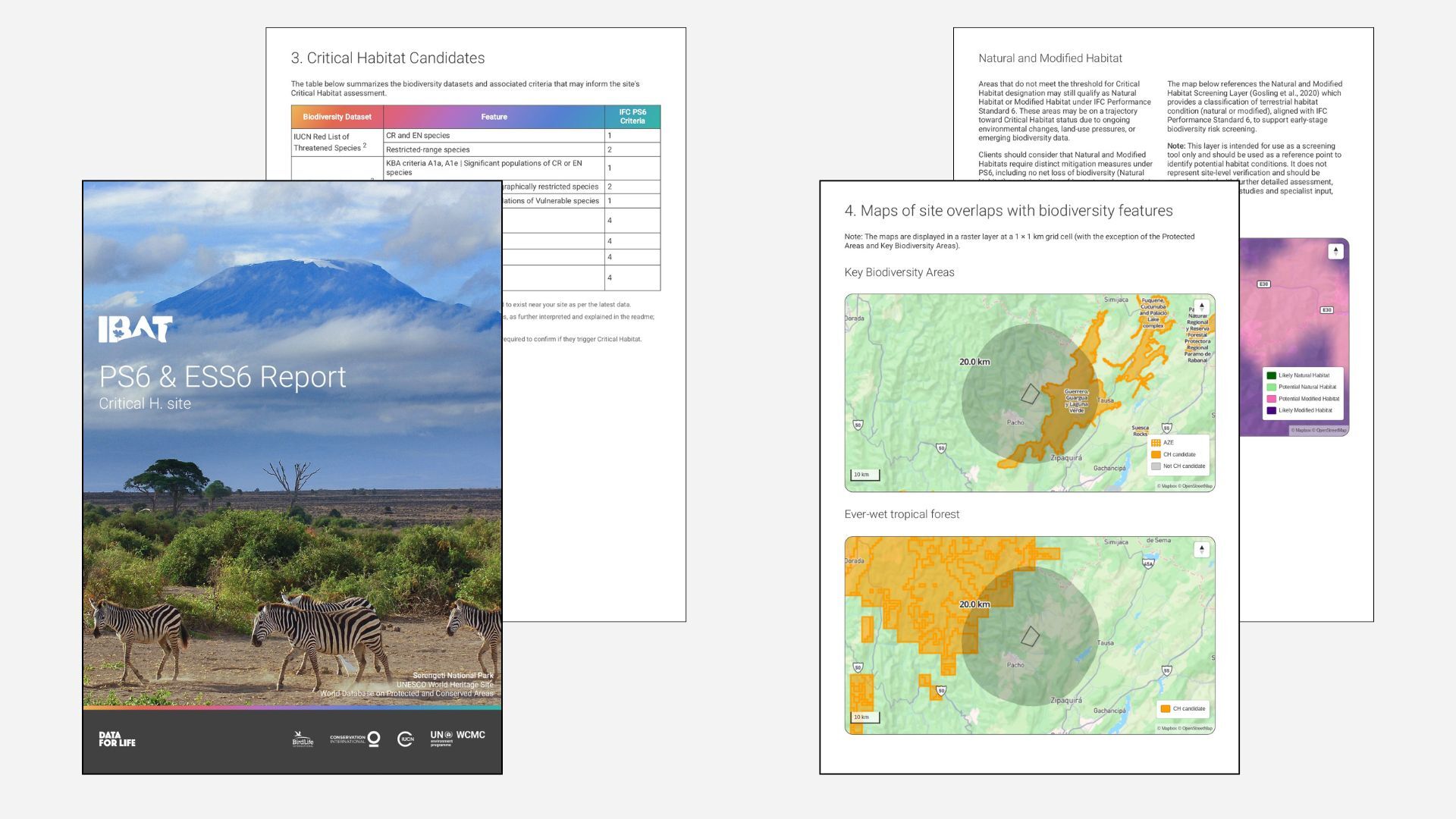
• Aside from the authoritative biodiversity data coming from the three core databases in IBAT, the report incorporates an additional analysis layer for early identification of likelihood of Critical Habitat: Developed by UNEP-WCMC, this layer draws on 19 additional biodiversity datasets identified in the UNEP-WCMC Critical Habitat screening layer translated into 54 distinct triggers.
• Dedicated restricted-range species output: A new output is provided for restricted-range species, as defined in the 2019 IFC PS6 Guidance Note 6. This includes an improved analysis on the Extent of Occurrence (EOO) and its overlap with the site’s Area of Influence.
• Guidance on further assessment: The new report goes beyond the screening results by providing recommendations on potential next steps for Critical Habitat evaluation. This helps users better understand how to apply the screening results, making the assessment process more comprehensive and actionable.
• Customisable buffer selection: Users can select a buffer distance between 0 km and 50 km around a site boundary, supporting more flexible screening that reflects a project’s area of influence.
• Expanded site-level metrics: Enhanced outputs for Key Biodiversity Areas (KBAs) now include information on specific trigger species and ecosystems.
• Enhanced visual outputs: The downloadable PDF report now includes individual maps for each dataset trigger, improving transparency and supporting internal documentation.
Additional updates include the consolidation of all data outputs into a single Excel file, and the inclusion of the Natural and Modified Habitat layer developed by UNEP-WCMC (2020).
What this means for organisations and financial institutions?
The report provides a screening output that categorises the likelihood of biodiversity features meeting critical habitat thresholds based on the data available. These outputs offer a stronger evidence base for understanding site-level biodiversity risks and help inform more detailed assessments, including the determination of potential critical habitat.
For financial institutions adopting the Equator Principle, Principle 3: Applicable Environmental and Social Standards, references the IFC Performance Standards as guidance to assess a project’s risk. Similarly, multilateral development banks, including the Asian Development Bank (ADB)’s Environmental and Social Frameworks and the Development Bank of Latin America and the Caribbean (CAF)’s Environmental and Social Management Framework for CAF's operations (ESMF), have developed environmental and social frameworks based on the IFC Performance Standards.
IFC PS6 is also widely referenced as good practice in biodiversity risk assessment, including in the OECD Guide on due diligence in mineral supply chain, and the ICMM Good Practice Guidance for Mining and Biodiversity.
It is important to note that the PS6 & ESS6 Report is designed to support initial risk screening and scoping, not to replace project-specific ecological surveys or expert judgement
Report Accessibility
For IBAT subscribers, the number of PS6 & ESS6 reports included remains unchanged.
For Pay-As-You-Go (PAYG) users, the price of the PS6 & ESS6 Report is now USD $1,250, reflecting the expanded scope, additional datasets, and enhanced analytical outputs.
These updates further strengthen IBAT’s support for biodiversity risk screening, enabling organisations to align more closely with international standards and make more informed decisions at early project stages.
Book a free demo with our team to learn more or contact us at ibat@ibat-alliance.org - we’d love to hear from you.