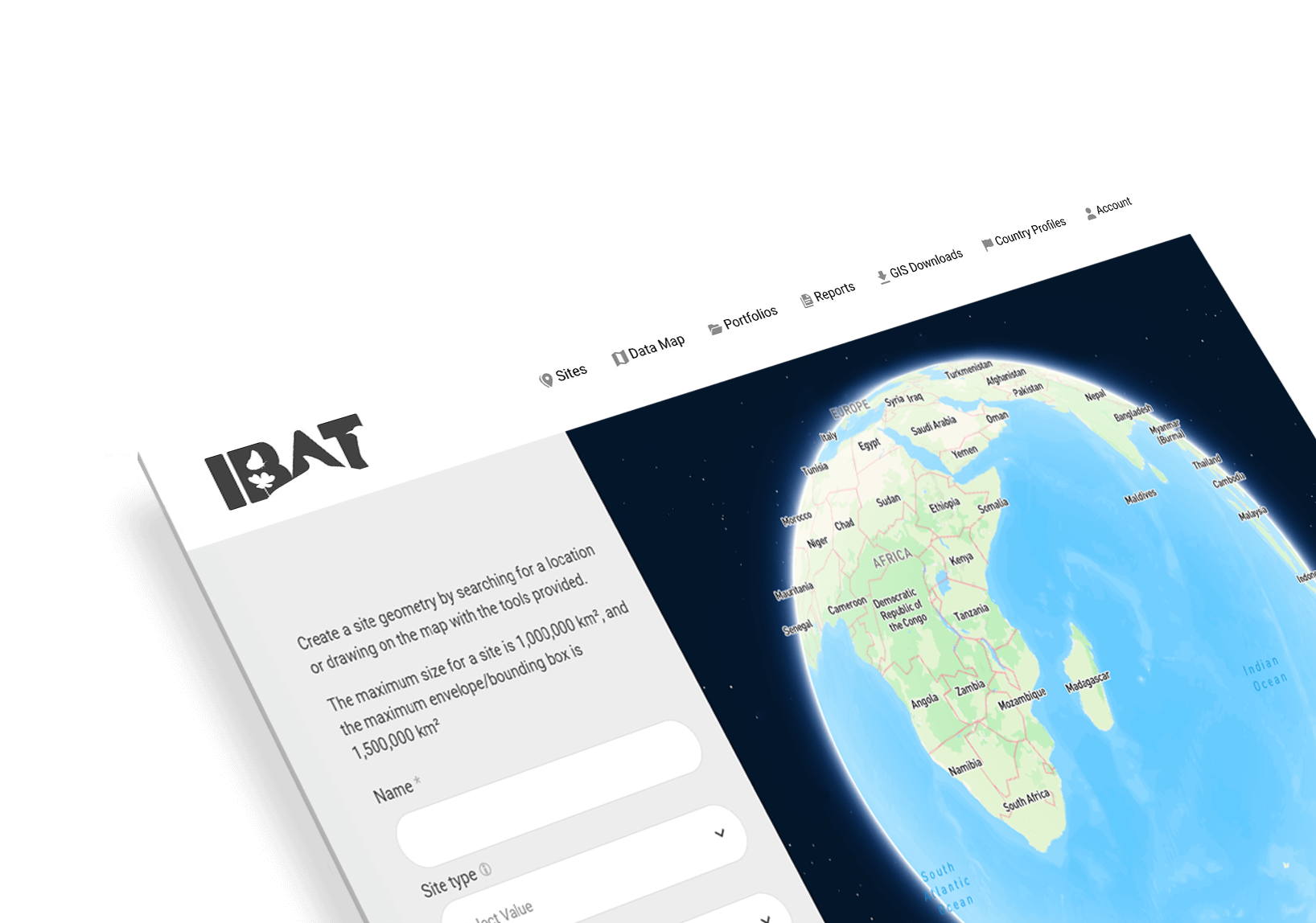
On 12 – 13 May, IBAT is joining the Nature Action Dialogues to host a series of high impact sessions.
The theme this year is Countdown to 2030: Aligning Ambition, Scaling Integrated Action
Read more about our sessions, below. We look forward to seeing you there!
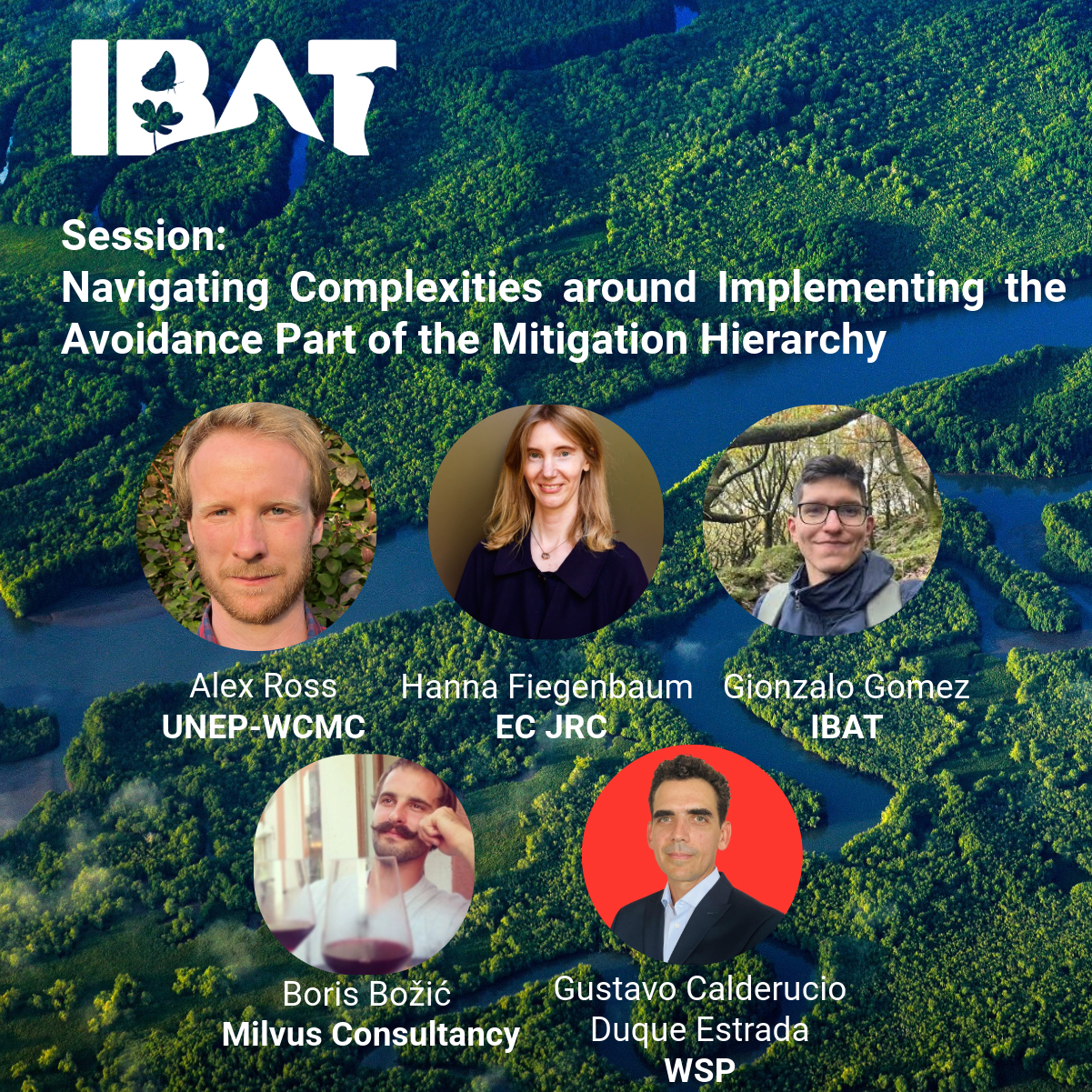
Navigating Complexities around Implementing the Avoidance Part of the Mitigation Hierarchy (90 minutes)
Hosted in collaboration with the IUCN CEM Impact Mitigation and Ecological Compensation (IMEC) Thematic Group, this session explores the complexities and practical solutions around implementing the avoidance stage of the mitigation hierarchy and reframes how avoidance is understood and applied in business and asset-related decision-making.
The session opens with a presentation from the IMEC team, establishing a common understanding of impact avoidance before moving into the session's central argument: that avoidance should be understood not merely as a compliance obligation or project risk to be managed, but as a driver of business and asset value. This reframing, from regulatory constraint to proactive value component sets the conceptual foundation for the discussion that follows.
The presentation will clarify what avoidance truly means in practice: not simply the spatial relocation of operations, but the genuine prevention of impact. It will explore the distinction between impact avoidance and location/footprint avoidance, the role of scenario analysis in early-stage decision-making, and no-go area designations, including the WDPCA, WDKBA, World Heritage Sites, and AZE sites, and their basis in IFC Performance Standard 6, and the complexities that arise from the voluntary nature of such designations. It will also address sector realities in energy, mining, and linear infrastructure, where avoidance constraints make the case for early and proactive biodiversity integration even more important.
A critical enabler of effective avoidance in practice is access to authoritative, decision-ready biodiversity data. IBAT provides integrated access to the world's leading datasets for identifying biodiversity risk at the site level, including the World Database on Protected Areas (WDPA) and the World Database of Key Biodiversity Areas (WDKBA), which encompasses Alliance for Zero Extinction (AZE) sites and World Heritage Sites.
These are precisely the designations that underpin no-go area definitions under IFC PS6 and that determine where avoidance obligations are at their most stringent. By using IBAT, practitioners can rapidly identify whether a proposed site intersects with these areas, supporting earlier, better-informed avoidance decisions and providing a defensible evidence base for demonstrating implementation of the mitigation hierarchy.
Speakers
• Alex Ross (UNEP-WCMC, Senior Programme Officer)
• Gustavo Calderucio Duque Estrada (WSP, Biodiversity Lead)
• Boris Božić (Milvus Consultancy, Nature Conservation Consultant)
• Hanna Fiegenbaum (External Expert to the EC JRC)
• Gonzalo Gomez (IBAT Programme Officer)
Project Finance and Nature Navigating the New IBAT PS6 Report (60 mins)
As global financial institutions increasingly align with the Equator Principles, the ability to identify biodiversity risk with precision is essential for project bankability. While the Kunming-Montreal Global Biodiversity Framework (KMGBF) sets the global ambition for a nature-positive future, the IFC Performance Standard 6 (PS6) remains the best practice guidance for implementing these goals at the project level.
This session introduces the latest updates to the IBAT IFC PS6 Report. Designed for a range of users from environmental specialists to financial risk managers, we will demonstrate how the updated report utilises authoritative global data to assist in the identification of Critical Habitats. The session will highlight practical considerations for applying biodiversity data consistently across projects, helping companies and lenders navigate complex PS6 expectations with greater confidence and clarity.
Key topics covered in this session:
• IFC speaker (Maria Estella Nucci) provides IFC's perspective and how lenders like the World Banking Group tackle biodiversity assessments through tools like IBAT and their role in project finance
• Alex Ross (UNEP-WCMC) presents the new Critical Habitat Screening layer — increased granularity, additional datasets, and how triggers inform next steps
• Megan Sim (IBAT) provides a walkthrough and demo of the IBAT’s updated PS6 & ESS6 report (launching in May)
• The sessions closes with a look ahead at planned IBAT enhancements (CH GIS layer, Area of Habitat data) and alignment with evolving standards
Speakers
• Ed Ellis, Senior Advisor, IBAT
• Maria Estella Nucci, IFC, Environmental Specialist- Biodiversity
• Alex Ross, Senior Programme Officer, UNEP-WCMC
• Megan Smith, Programme Officer, IBAT

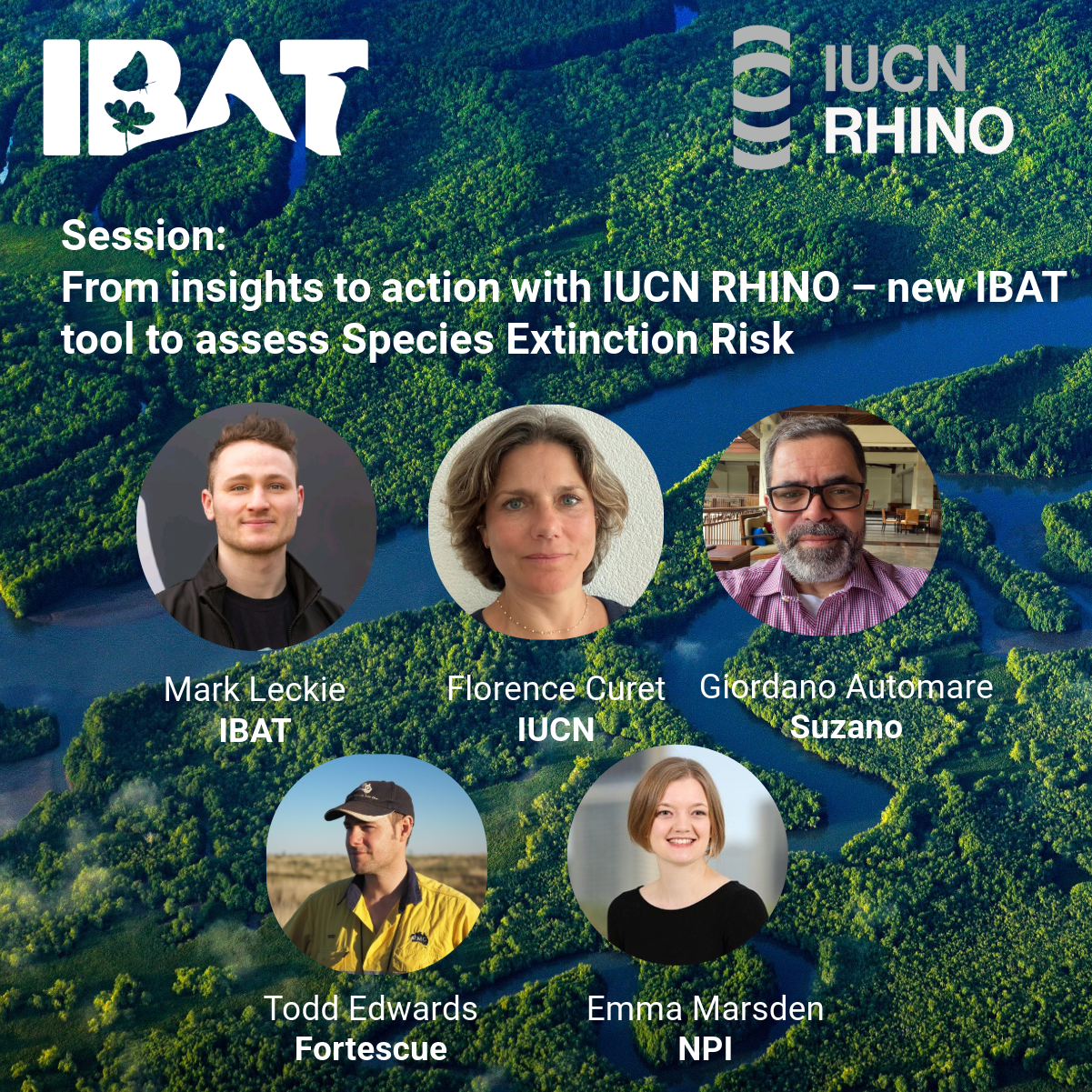
From insights to action with IUCN RHINO – new IBAT tool to assess Species Extinction Risk (90 mins)
The IUCN RHINO approach provides a step-by-step methodology to support the delivery of Rapid High-Integrity Nature-Positive Outcomes, offering organisations actionable insights to understand their interface with nature and begin taking meaningful action now.
This session brings together pioneers and early adopters of the RHINO approach to share concrete case studies from the extractive and forestry sectors including Fortescue and Suzano demonstrating how the methodology has been applied in real-world operational contexts. Early adopters have relied on manually compiled files to calculate the Species Threat Abatement and Restoration (STAR) score of their pilot areas, a metric derived from the IUCN Red List of Threatened Species and used by IUCN RHINO to measure contributions to the Kunming-Montreal Global Biodiversity Framework(GBF).
Presenters will explain how this work has helped organisations assess their species extinction risk and identify opportunities to contribute to global biodiversity goals. Following each presentation, there will be opportunities for open discussion, providing a valuable forum for shared learning and honest reflection on implementation challenges.
The session will also showcase the new IBAT STAR calibration tool, which will make this assessment more accessible. Participants will learn how to use IBAT species reports and understand what information is needed to produce, with the new IBAT tool, a robust analysis that informs decision-making.
Speakers
• Todd Edwards, Manager, Nature and Science at Fortescue
• Emma Marsden Technical Manager, Nature Positive Initiative
• Giordano Automare, Sustainability Executive Manager at Suzano
• Florence Curet, Senior Programme Manager, Business and Nature at IUCN
• Mark Leckie, Programme Officer at IBAT
For more information and to view the full agenda, visit the Nature Action Dialogues website.