For financial institutions assessing biodiversity risk, one of the practical challenges of applying International Finance Corporation Performance Standard 6 (IFC PS6) is determining where to concentrate due diligence efforts. Early-stage project screening needs to be sufficiently robust to identify potentially material biodiversity risks; at the same time, data alone cannot determine Critical Habitat or replace required site-specific assessment and expert consultation.
The updated IBAT PS6 & ESS6 report is designed to help bridge this gap. It brings together authoritative biodiversity data and insights in a format that can support early screening against the biodiversity guidelines underpinning IFC PS6 and the World Bank Environmental and Social Standard 6 (ESS6), helping users identify where further investigation may be required.
The following illustrative solar project in Colombia demonstrates how the IBAT PS6 & ESS6 could be used as an input to a wider PS6-aligned assessment.
How the IBAT PS6 & ESS6 could support a renewable energy project with PS6 alignment: A Case Study *
A Solar Photovoltaic (SPV) project proposed in Colombia seeks alignment with IFC PS6 to secure investment from a multilateral development bank. The developer must assess biodiversity risks, determine the presence of Critical Habitat as defined by the standard, and apply the mitigation hierarchy using robust biodiversity data.
Early Screening of possible Critical Habitat
The developer screens for areas of biodiversity sensitivity to determine whether the project may impact Critical Habitat and to define alignment with IFC PS6.
Using the IBAT PS6 & ESS6 report, the developer conducts a desktop study to explore an Area of Influence (AoI) within a 5km buffer of a project. The study identifies potential biodiversity features that require further assessment to confirm Critical Habitat:
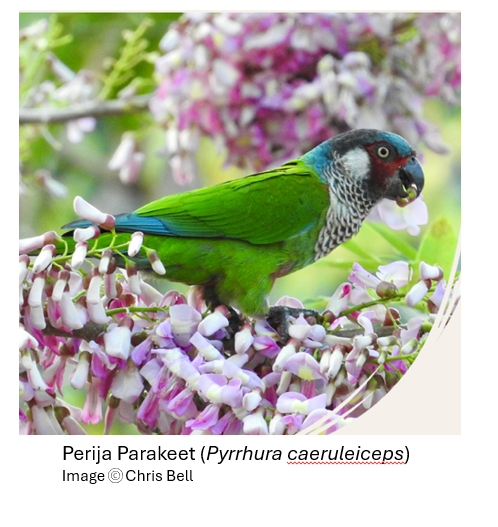
• Perija Parakeet (Pyrrhura caeruleiceps, Endangered), whose mapped Extent of Occurrence (EOO) potentially overlaps with the project AoI is used as a proxy for population significance (Criteria 1 candidate).
• A possible restricted-range species, Indistinct Ground Snake (Data Deficient), a terrestrial vertebrate whose mapped EOO overlaps with the entirety of the AoI (Criteria 2 candidate).
• From all screened species, 183 are identified as migratory and 65 congregatory, many associated with freshwater habitats, although no population data is available to assess significance against the relevant thresholds (Criteria 3).
• Presence of Tropical montane cloud forest ecosystem, which requires assessment of threat status and extent (Criteria 4 candidate).
• No areas associated with key evolutionary processes are identified from the data available (Criteria 5).
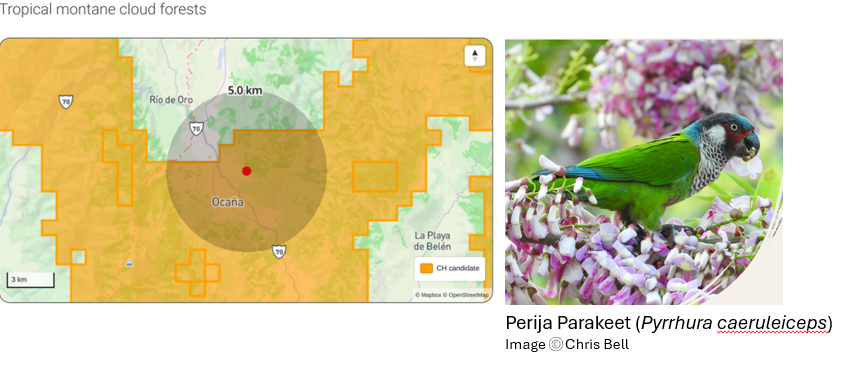
This information provides an early indication of where biodiversity risk may be material and where additional evidence should be requested.
Critical Habitat Determination
The initial screening is complemented with additional sources: national biodiversity datasets, expert consultation, site-specific ecological surveys and impact assessments as part of the project’s Environmental and Social Impact Assessment (ESIA). From the broad pool of data obtained, feature-specific Ecologically Appropriate Area of Analysis (EAAA), beyond the project AoI, were defined, covering ecological requirements, including relevant terrestrial habitats.
The EAAA informs the scope and scale of Critical Habitat Assessment(CHA) and impact assessment, supporting:
• Confirmation of species presence and criteria thresholds.
• Identification of priority habitats (e.g. tropical forests).
• Assessment of functional features such as corridors and cumulative effects.
• Mapping of ecosystems potentially impacted.
• Assessment of direct, indirect, and cumulative biodiversity impacts.
Translating biodiversity findings into the mitigation hierarchy
CHA findings were evaluated and refined through a project-level ESIA, including forest-dependent bird movement and activity surveys (informing collision or electrocution risk) and targeted herpetofauna surveys for the Indistinct Ground Snake, given it has a Data Deficient status. The developer designs a Biodiversity Action Plan to mitigate biodiversity and ecosystem service impacts, following the mitigation hierarchy, with the aim to achieve No Net Loss (NNL) in natural habitat and net gain for biodiversity features for which Critical Habitat has been determined.
The plan looked like this:
Avoid
• Exclude solar array, access roads and any transmission lines from confirmed Tropical Montane Cloud Forest and gallery forest patches within the EAAA.
• Avoid loss and fragmentation of confirmed parakeet habitat, including forest patches, breeding/nesting sites and habitat that contribute to functional connectivity.
• Where occupied habitat is confirmed for the Indistinct Ground Snake, avoid ground-disturbing activities within those areas and maintain habitat connectivity.
Minimise
• Minimise forest clearance and fragmentation while maintaining functional connectivity between forest patches.
• Control construction noise, lighting and traffic timing near forest patches.
• Enforce worker awareness training for no-capture policy, given known trapping pressure on bird species from capture and wildlife trade.
• Incorporate a bird-safe design measure from associated infrastructure where collision or electrocution risks are identified.
Restore
• Revegetate areas with native montane forest species to restore structural habitat.
• Restore any cleared forest-edge and understory areas post-construction using native species and, where feasible, restore connectivity between retained forest patches.
Offset (proposed only after appropriate application of previous steps)
• Design offsets specifically in Tropical montane cloud forest within the species’ EAAA.
• Set a measurable net gain targets for the parakeet, including population and habitat monitoring.
• Use survey and monitoring results to refine the conservation objectives for Indistinct Ground Snake to determine whether specific compensation actions are feasible due to its DD status.
Specialist advisors, from the private sector and local government, helped the business design offsets and set net gain targets in line with national conservation priorities.
A practical role in the project lifecycle
The case study illustrates how financial institutions can achieve a more systematic and transparent approach to biodiversity due diligence, and move from a broad question of “Is there biodiversity risk here?” to a more actionable assessment of biodiversity features, additional evidence required, how negative impacts can be avoided and minimised, and what residual risks may remain.
The CHA is an iterative process, requiring careful consideration to avoid under or overestimating the presence of Critical Habitat. Actions under the mitigation hierarchy are iterative and applied throughout the project life cycle. In line with PS6, emphasis should be placed on Avoidance and Minimisation before considering Restoration and, where residual impacts remain, Offsets.
Find out more
To learn more about how the IBAT PS6 & ESS6 report can support your biodiversity risk screening and investment decisions, book a demo with our team, we would love to hear from you.
*This case study is illustrative only. Biodiversity risks and mitigation measures will vary depending on location, project design, methodology, and ecological context. Additionally, different approaches may be taken to identify Critical Habitat and reach alignment with IFC PS6.